Recently launched at the Metropolitan Museum of Manila is the TouchBooks: The Tactile Textbook Project, a pioneering publication project of educational images useful and intelligible to the visually-impaired Filipino students. Visual impairment is one of the major physical disabilities in the country, with available data in Resources for the Blind, Inc. reveals that 3.7 million Filipinos are afflicted with blindness and severe impairments such as extremely low vision. The Philippines ranks the 4th highest in the World.
Among the visually-impaired children, the number of those able to enroll in school is historically low, while those who avail of education are faced with numerous hindrances to proper learning. The TouchBooks project utilizes art education tools that benefit the SPED teachers for the blind and their students. Teaching and learning becomes easier.
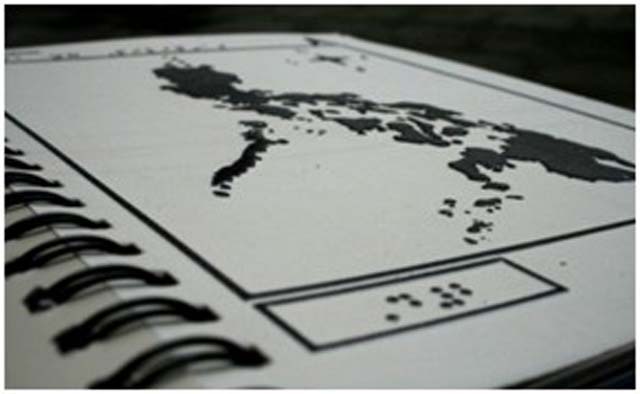
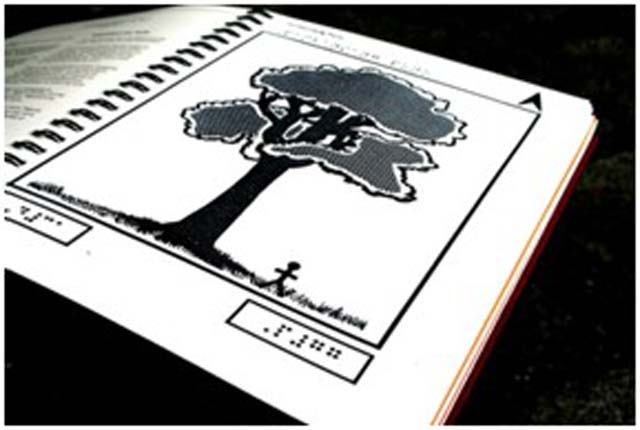
The inaugural publication of TouchBooks is the Makabayan: Sibika at Kultura? Hekasi. It features more than seventy drawings of key images and concepts discussed in basic elementary lessons in social studies, the important foundation subject that shapes the children’s ideas on nationalism, identity and society. This tree-volume book by authors Annette Lee Esparaz, Evelyn B. Caja, Julie R. Capulong and May Lyn L. Cruz, is the first book for the blind in the country that is non-exclusively Braille and written in the Filipino language.
The proponent, Rotary Club of San Juan del Monte, D3800, Past President and Director for Community Service Annette Esparaz, a graduate of Cultural Heritage Studies at the UST, explains the concept behind the book: “Ideas and concepts are more quickly absorbed by school children when accompanied by visuals such as pictures and drawings. The same applies to children who are visually-impaired. Their lack of sight does not imply lack of imagination. On the contrary, their ability to visualize is so developed that they surprise even the most imaginative among the sighted people.”
How does the Makabayan book of drawings become intelligible to the blind? It uses the tandem approach of tactile drawings and narrative guide. This system is based on more than a decade research and study of Art Education for the Blind, Inc., “their fundamental belief that people who are blind or visually impaired must have access to the world’s visual culture”.
The tactile drawings are printed on special swell paper which has microcapsules of alcohol embedded on it. When fed to a heat diffuser printer, the drawn images become raised and can be interpreted using touch.
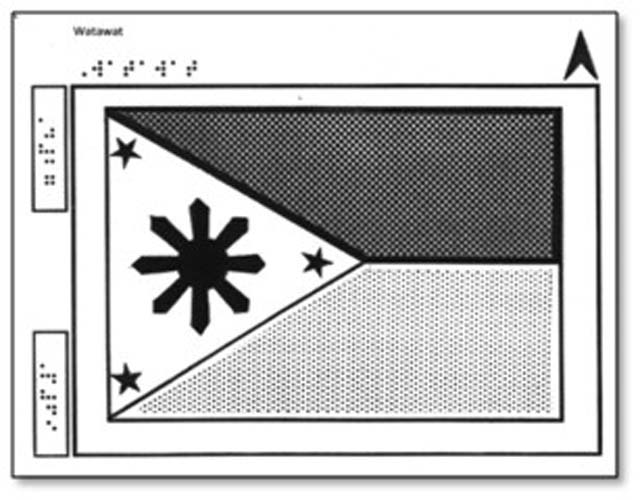
Capulong, a veteran SPED teacher for the blind at P. Gomez Elementary School and 2005 Metrobank Outstanding Teacher Awardee, explains the tactile drawings further: “We do the drawings with different patterns and textures to differentiate objects, colors, spaces, etc. For the Philippine flag, for example, we used the basket-weave pattern for the blue band, and the dotted pattern for the red band. When the blind touches it, he immediately recognizes that upper part is different from the lower part.”
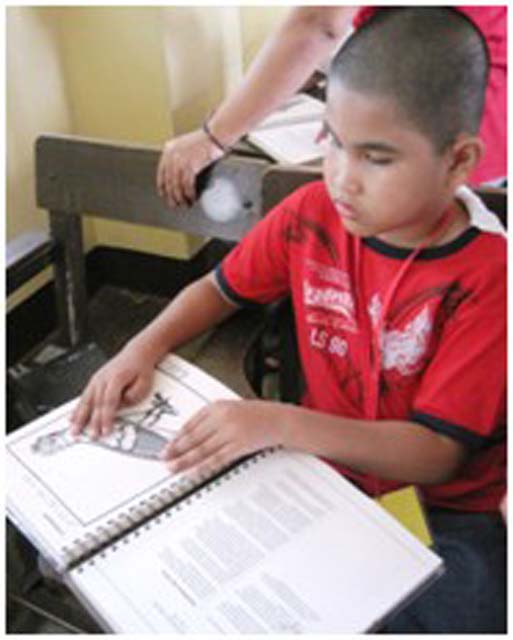
Each image is accompanied by a narrative guide. Cruz, who is also curator of Metropolitan Museum of Manila, explained: “This is the script which guides the blind on how look and understand the drawing. It always begins from the orientation arrow, the point of reference always located at the upper right corner of the drawing frame. From there, the script tells the blind, say, to move left and down for a number of inches into the drawing until he sees a certain pattern or line, which is, say, the flags that line Rizal Park, and from there move to a certain direction until the overall picture is revealed. The text is printed on the left side of the book, the drawing on the right side. This way, the teacher and the student can sit side by side, the teacher will read, the blind will look with his hands. We also provided an audio CD of the same script, in case the teacher is too tired to read. This is especially helpful if she is handling several blind students in her class.”
The book is an ambitious project that addresses a real need. Caja, whose dedication to teaching the blind at the Ramon Magsaysay High School has been recognized with multiple awards and an elevation to the DepEd Hall of Fame last year, shares the objective of the book: “We want to help the SPED teachers for the blind. Before TouchBooks, there were really no tactile teaching tools available for teachers. We had to improvise – strings and collage on cardboard paper, incised textures on tracing paper – these all depended on how imaginative and energetic the teacher was. And we also want to standardize. We can certainly help guide the blind students so that their image of the map of the Philippines, of the Rice Terraces, of the Philippine eagle and all these things important to us as Filipinos are the same as what see.”
The Makabayan TouchBook is composed of three volumes, each accompanied with an audio CD. “In spite of the gratis work by all four authors the discounted rates given to us by our production partners, the book cost is still quite substantial because of the special materials and production processes it entailed.
With the generous support different organizations, especially the Rotary Club of San Juan de Monte District 3800, we were able make the book into a reality,” Esparaz notes. This is the flagship project of the club for this Rotary year. With the theme “Building Communities, Bridging Continents” we campaign for donors to purchase the book for donation to SPED Centers in their communities and all over the country.
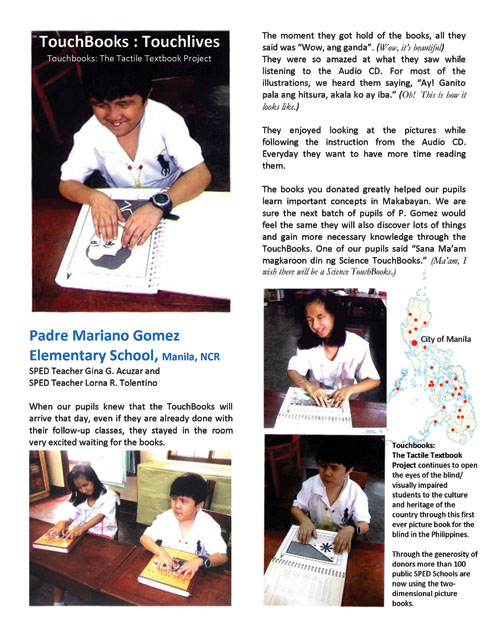
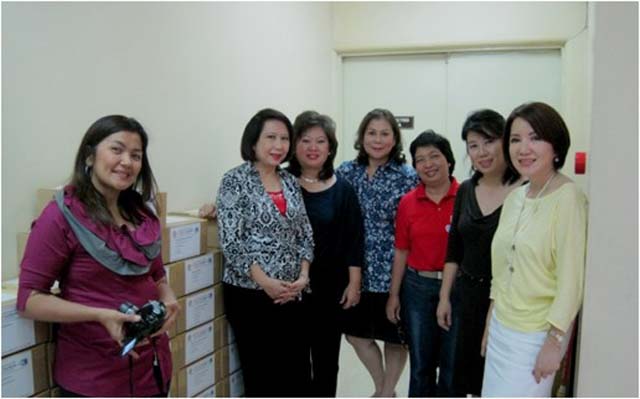
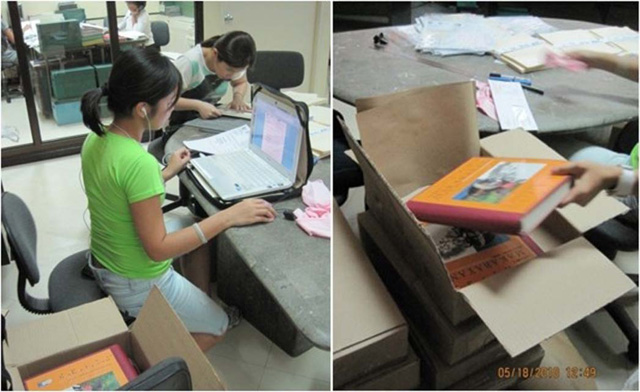
To date, 100 sets of Touchbooks had been distributed to the different SPED/Public schools and blind students all over the Philippines. SPED teachers are using these instructional materials to explain history and geography to their excited students.
We continue to create awareness and hope to provide one TouchBooks for each of the 409 SPED (Special Education) centers catering to mainstream blind/visually impaired student nationwide.